Getting Out the Door
Every street photographer has stood at the door not going out. The camera is charged, the light is fine, and something — no ideas, last time's flat results, the suspicion that everyone else is better — keeps you inside. This page is about that gap between wanting to photograph and photographing. Closing it is the entire reason Street Manual exists.
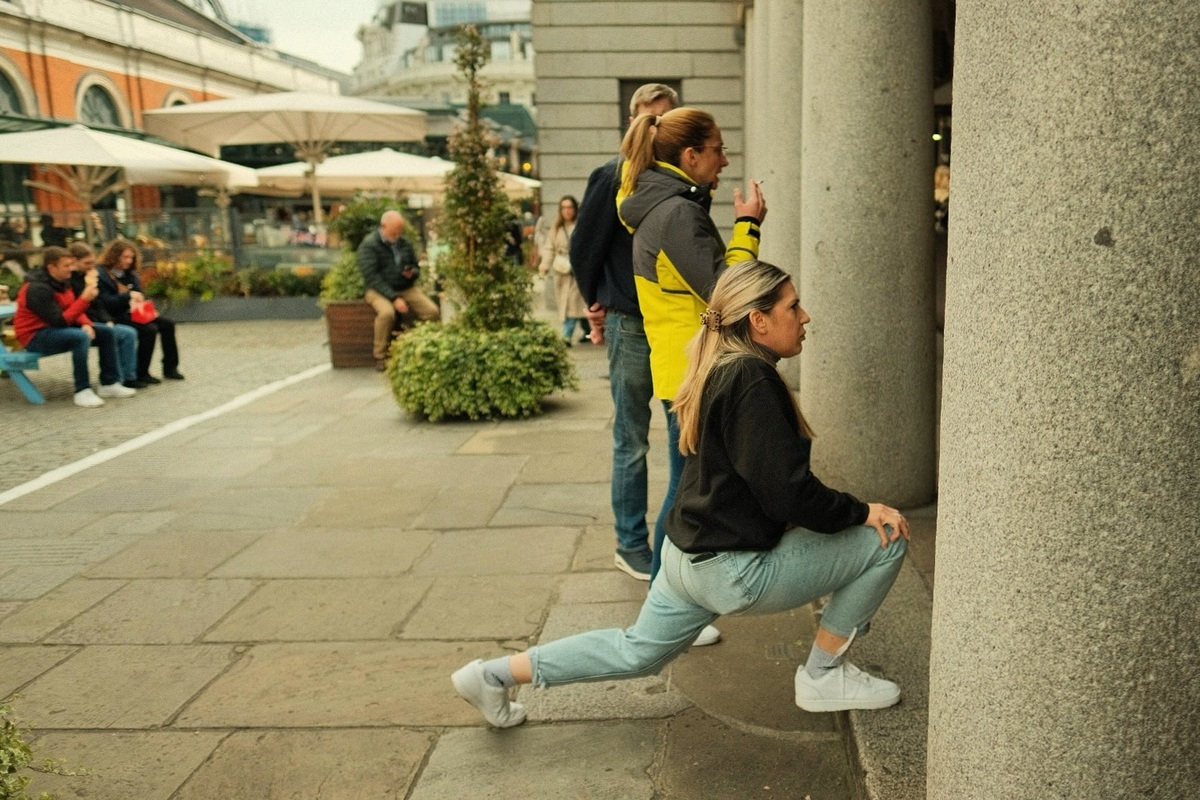
Motivation is downstream of action
The waiting-to-feel-inspired model of creativity has it backwards. Inspiration does not precede shooting; it is produced by shooting. Ten minutes into a walk, the street starts offering things — a shadow, a coat, an alignment — and the state you were waiting for at home arrives on the pavement. It almost never arrives anywhere else.
This is why the professional habit is structural, not emotional: photographers who sustain a practice do not consult their feelings about whether to go out, any more than runners consult their feelings about the first kilometre. The feeling is bad at the door, neutral at ten minutes, and good at thirty — every time, for everyone. Once you know the sequence is fixed, the bad feeling at the door stops being information. It is just the door.
The blank slate is the real enemy
Most of what feels like self-doubt is actually decision paralysis wearing doubt's clothes. 'Go out and take great photos' is an unanswerable brief — no starting point, no definition of done, and infinite ways to fail. The brain treats unanswerable briefs the way it treats all open loops: with avoidance.
The fix is embarrassingly effective: replace the infinite brief with a finite one. 'Photograph leading lines for an hour' is answerable. 'Shoot only red today' is answerable. 'Work one corner for thirty minutes' is answerable. A constraint converts the terrifying question am I any good? into the workable question did I do the assignment? — and you can always do the assignment.
This is the entire design theory of the deck: each card is one finite brief. Draw, go, done. Not because prompts are magic, but because the decision they remove — what am I even looking for? — is precisely the one that keeps people indoors. The Inspire Me dial exists for the days when even choosing a card is one decision too many.
Recalibrating what good looks like
The other engine of doubt is a broken benchmark. You compare your afternoon's take against a feed of other people's best-ever frames — a portfolio distilled from years — and conclude you are failing at something everyone else finds easy.
The actual numbers, for everyone, amateur and master alike: one or two keepers per outing is a good day. The published contact sheets of the greats show dozens of misses around every famous frame. Garry Winogrand shot obsessively precisely because he understood the arithmetic — quality is a percentage of volume, and the percentage is small for every human who has ever held a camera.
So judge sessions by process, not product: did you go, did you work the brief, did you stay out the full hour? Those are the inputs you control, and they are the only inputs that exist. The keepers arrive on their own schedule, statistically, from the sessions you showed up to. A 'bad' session is not evidence about your talent. It is one data point in a numbers game you win by playing.
A system for the bad days
Confidence that depends on feeling confident is no system at all. Build the version that runs anyway:
Shrink the unit. The commitment is never 'a proper shoot' — it is fifteen minutes on the way to somewhere you were already going. The Focus Log exists to make small sessions count visibly; a streak of short outings beats a monthly epic for both skill and morale.
Pre-decide everything decidable. Card drawn the night before, camera pre-set (Sunny 16, zone focus), bag by the door. Every decision moved out of the weak moment strengthens it.
Log one line per session. What you shot, one thing you noticed. Doubt thrives on the illusion of no progress; a log is the antidote you can reread.
Let the streak carry you. After a dozen small sessions, going out is simply what you do — identity does the work motivation used to. The photographers you admire are not the ones who never doubted. They are the ones whose system did not care.
And the quiet truth underneath all of it: nobody on the street is evaluating you. They are thinking about their own lunch, their own messages, their own doubts. The audience you fear is not there. The pictures are.
Field Questions
How do I get motivated to go out and shoot?
Stop waiting for motivation — it follows action rather than preceding it. Shrink the commitment to fifteen minutes, give yourself one finite brief (a single card, colour or technique), pre-set the camera, and go. The wanting-to arrives about ten minutes into the walk.
Why are all my street photos bad?
They almost certainly are not — your benchmark is broken. One or two keepers per outing is a good day for everyone, including the masters, whose contact sheets show dozens of misses around each famous frame. Judge yourself on sessions completed, not on matching a stranger's ten-year highlight reel.
How do I stop comparing myself to other photographers?
Compare trajectories, not outputs: your work this month against your work six months ago. Keep a one-line session log so progress is visible, and treat feeds as reference libraries rather than scoreboards — you are seeing everyone's best-ever, never their Tuesday.
What if I go out and find nothing to photograph?
That is the blank-slate problem, not an empty street — with no brief, nothing registers. Constrain the search: one colour, one technique, one corner for thirty minutes. Attention needs a target, and the moment it has one, the same street produces.